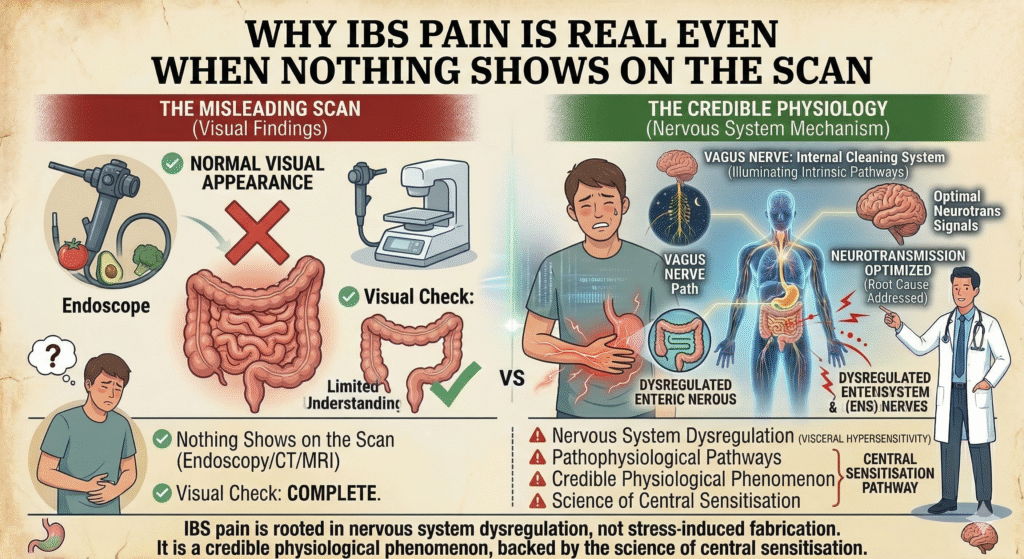
The myth of “it’s all in your head” when it comes to IBS has persisted far too long. This narrative is not only scientifically inaccurate but clinically negligent. Patients with IBS experience real pain due to central sensitisation, a process where the nervous system becomes hyperactive and reactive. Advanced imaging may not capture this, but it doesn’t negate the palpable agony felt by sufferers.
IBS Pain Is Rooted in Nervous System Dysregulation
IBS, or Irritable Bowel Syndrome, presents a conundrum: real pain, but no visible pathology on a standard scan. This is where the role of the nervous system becomes critical. Central sensitisation transforms the usual perception of gut discomfort into extreme pain. The vagus nerve, a pivotal player in the gut-brain communication loop, malfunctions in this state. Here lies the crux of many unexplained gut issues. When the vagus nerve malfunctions, it leaves the gut vulnerable to stress-based triggers, escalating sensitivity. The enteric nervous system becomes an unwitting participant in this cycle of exaggerated pain signals.
The gut-brain axis functions not merely as a messenger but as a modulator. Neurotransmitters like serotonin, predominantly produced in the gut, affect mood and bowel function. But in the landscape of central sensitisation, even normal gut stimuli trigger amplified pain responses. Without intervention, this dysregulation becomes a relentless feedback loop, misinterpreted by the uninitiated as anxiety or mere stress.
Don’t mistake invisibility on a scan as absence; central sensitisation redefines how we perceive the relationship between gut symptoms and nervous system phenomena.
The Enteric Nervous System: The Second Brain’s Role
Within your gut resides the enteric nervous system (ENS), often termed the “second brain.” It is autonomous yet intimately connected to the central nervous system via the gut-brain axis. When IBS symptoms flare, it’s the enteric nervous system’s miscommunication that’s partly to blame. This secondary brain holds over 100 million neurons, more than the spinal cord, indicating its central role in gastrointestinal processes.
Polyvagal theory sheds light on this interplay, particularly the influence of the vagus nerve on gut function. Normally, the vagus nerve aids digestion and stress regulation. However, when dysregulated, it results in symptoms often tagged as unexplained gut issues. A hyper-alert state, prompted by stress-based triggers, spells disaster for gut equilibrium.
It’s not about an absent disease but a system misfiring on a fundamental level. Clinical mechanisms like afferent nerve pathways become hypersensitive, relaying overstated signals of discomfort. Where traditional medicine falls short, neuroscience offers clarity: your pain is as neurological as it is gastrointestinal.
Pathophysiological Pathways: Understanding the Pain
Delving into the micro-level, enzymes and their interactions illuminate more. The transient receptor potential (TRP) ion channels are pivotal in sensory neuron activation and pain perception. In IBS patients, these channels may become overly sensitive, leading to exaggerated responses even to normal digestive processes. This mechanism forms the epicenter of central sensitisation in IBS.
Further complicating this landscape is the perpetual state of low-grade inflammation often unnoticed in conventional tests. Pro-inflammatory cytokines fuel this fire, enhancing the sensitivity of nociceptors pain receptors. This is not a mere biochemical dance but a complex neuroimmune interaction that heightens the pain perception in IBS sufferers.
Understanding these pathways reframes IBS not as a psychosomatic disorder but as a tangible pathophysiological condition, intricately wired into the nervous system’s network. The evidence is not only compelling but commanding IBS pain is intensely real and scientifically validated.
The narrative must shift. IBS pain is not an illusion nor a figment of stress-induced fabrication. It is a credible physiological phenomenon, backed by the science of central sensitisation.
Leave a Reply