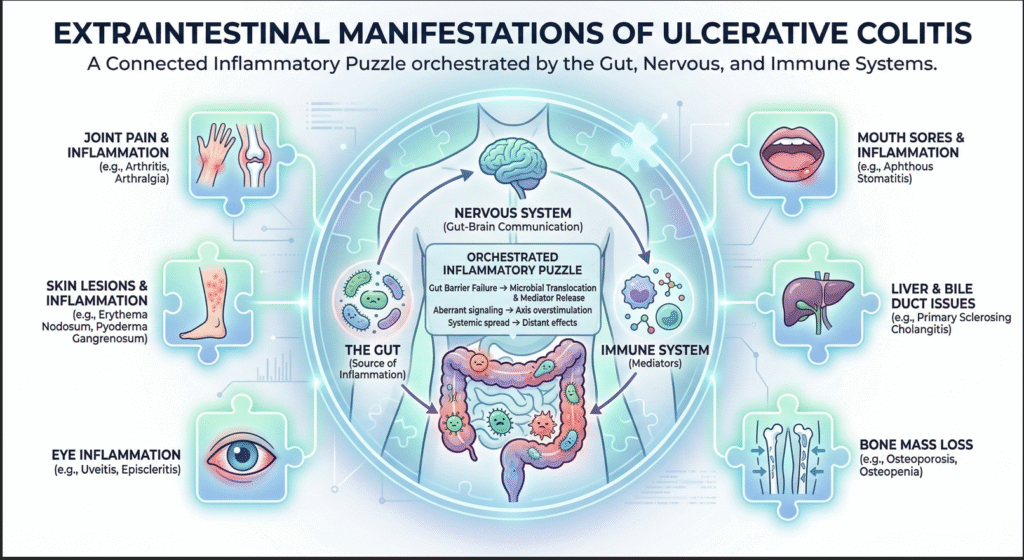
Myth: Ulcerative colitis only affects the gut. False. Ulcerative colitis (UC), a form of inflammatory bowel disease (IBD), is commonly misunderstood as a condition limited to the digestive tract. This is a dangerous simplification. UC extends its inflammatory reach far beyond the colon. Joint pain, skin eruptions, and eye inflammation are not separate conditions they are interlinked elements of a systemic disease.
The Vagus Nerve and Joint Pain: More than Incomplete Evacuation
It is not just about incomplete evacuation or bowel discomfort. Patients with UC often suffer from joint pain owing to the complex interaction between the gut and the nervous system. At the heart of this interaction is the vagus nerve, a critical component of the gut-brain axis. The nociceptive signals arising from the inflamed gut travel the vagus nerve, altering neuroimmune signaling and eliciting systemic inflammation affecting the joints. Remember, cytokines like interleukin-6 (IL-6) are not preoccupied with geography; they traverse barriers, exacerbating inflammation in synovial tissues. Even more pivotal is the role of the enteric nervous system hundreds of millions of neurons orchestrating gut and systemic harmony, or disharmony in the case of UC. Joint pain is not an isolated symptom; it is inflammation expressed elsewhere.
Skin: A Canvas of Gut Inflammation
Your skin is an immunological canvas, often mirroring the chaotic processes within the GI tract. With UC, the integrity of the gut lining is compromised, leading to increased intestinal permeability often dubbed ‘leaky gut.’ Zonulin, a protein that modulates tight junctions in the intestinal wall, is upregulated, leading to systemic exposure to antigens and microbes. These foreign entities trigger immune responses resulting in dermatological manifestations such as erythema nodosum and pyoderma gangrenosum. The connections between the skin and gut are not speculative; they are mediated through the autonomic nervous system, with dermal flare-ups representing the tip of systemic immune dysregulation. The skin is not the periphery; it is the reflection.
Ocular Inflammation: A Gut Symptom in Disguise
The eyes are often overlooked as symptoms of IBD emerge. Yet ocular inflammation such as uveitis or episcleritis flares in concert with intestinal activity. Immune complexes circulate through the bloodstream, induced by gut-derived endotoxins. These complexes might surprise only those uninitiated in the intricacies of the gut-brain-immune triad. The polyvagal theory describes how vagal tone influences systemic inflammation, including ocular tissues. Simultaneously, enzymes like matrix metalloproteinases (MMPs) become untethered in their activity during inflammatory states, degrading extracellular matrix components and sparking ocular conditions. Consider this: what is perceived as isolated ocular inflammation may be an extension of gut turmoil.
Extraintestinal manifestations of ulcerative colitis are not enigmatic clusters of unrelated symptoms. They are connected pieces of an inflammatory puzzle orchestrated by the gut’s delicate interplay with the nervous and immune systems.