If you live with chronic digestive distress, you may feel like your body is working against you. The unpredictable bloating, the anxiety that ties your stomach in knots, the feeling that you’ve tried everything without finding lasting relief—it can be an isolating and exhausting journey. But what if the key to healing wasn’t about fighting your body, but about learning to listen to its hidden wisdom? Welcome to the world of your enteric nervous system (ENS), often beautifully called your “second brain.” Here, we’ll gently discover the wisdom of this system and learn how nurturing it is the true key to calming your digestive distress and finding peace in your body again.
What is the Enteric Nervous System (Your ‘Second Brain’)?
In the simplest, most gentle terms, the enteric nervous system is your gut’s very own intelligent operating system. It’s a complex web of millions of nerve cells lining your entire digestive tract, from your esophagus to your colon. While it is connected to the brain in your head, it has the remarkable ability to work independently, managing the intricate dance of digestion all on its own. You can think of it as the deep, intuitive wisdom held within your gut, constantly working to nourish and protect you.
How Your Two Brains Communicate
Your two brains are in constant conversation through what is known as the gut-brain axis. This is a bidirectional communication pathway, meaning your brain talks to your gut, and just as importantly, your gut talks to your brain. The main superhighway for this conversation is the vagus nerve, a long, wandering nerve that connects the brainstem to the abdomen. This physical connection is why a “gut feeling” is a real, biological phenomenon. When your gut senses something is off, it sends a signal up the vagus nerve to your brain, creating that intuitive sense of unease or, conversely, a feeling of deep calm and rightness.
What Does Your Second Brain Do All Day?
Your second brain is tirelessly working behind the scenes to keep you healthy. It masterfully manages the rhythm of digestion, creating the wave-like muscle contractions (peristalsis) that move food through your system. It also controls the release of essential digestive juices and enzymes needed to break down your food and absorb nutrients. Furthermore, it acts as a vigilant protector, helping your immune system identify helpful bacteria from harmful invaders, and communicating with your brain to keep you safe.
When Your Gut’s Nervous System is Stressed
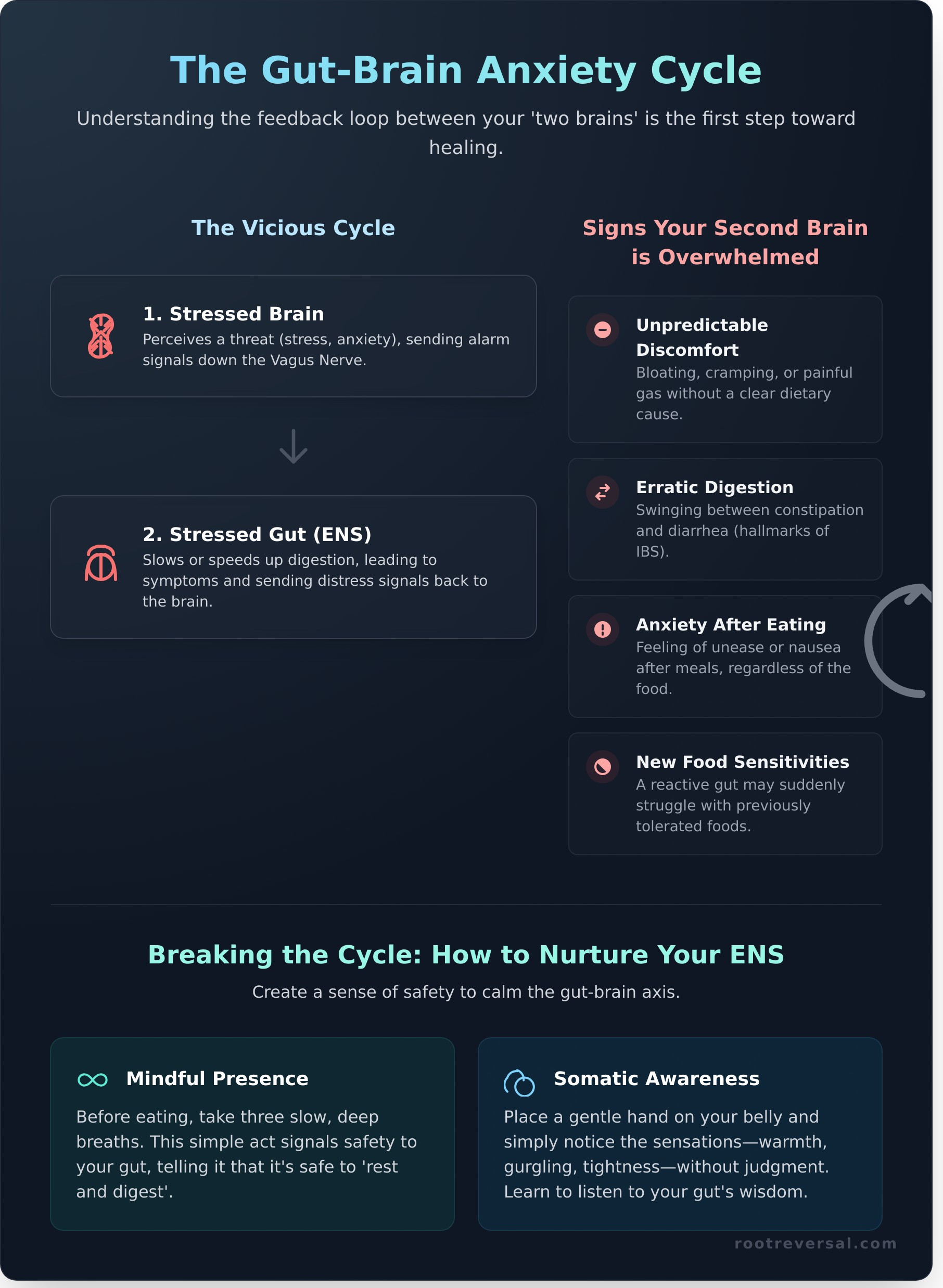
Just like you, your second brain can become overwhelmed by stress. When you are in a chronic state of fight-or-flight, your brain sends alarm signals down to your gut. In response, the ENS may slow down or speed up digestion erratically, leading to discomfort and distress. This is not a flaw in your body; it is a survival mechanism. Your body is trying to divert energy to face a perceived threat. For many people with chronic gut issues, this state of high alert has become the default, and it is often the true root cause of unexplained digestive symptoms.
Signs Your Second Brain is Crying for Help
When your enteric nervous system is dysregulated, it sends out signals for support. These are not signs that you are broken, but gentle invitations to pay closer attention. You may experience:
- Unpredictable bloating, cramping, or painful gas that seems to have no clear cause.
- Swinging between constipation and diarrhea, a pattern common in Irritable Bowel Syndrome (IBS).
- A feeling of anxiety, unease, or even nausea after eating, regardless of what you ate.
- New food sensitivities that seem to appear out of nowhere, as your gut becomes more reactive.
The Vicious Cycle of Gut-Brain Anxiety
A stressed gut doesn’t keep its feelings to itself. It sends a constant stream of alarm signals up the vagus nerve to your brain. Your brain, in turn, interprets these signals as danger, which can heighten feelings of anxiety, worry, and hypervigilance. This increased anxiety then sends more stress signals back down to your gut, telling it to stay on high alert. This creates a painful feedback loop that can feel impossible to escape. Feeling trapped in this cycle? Discover a path to regulation.
How to Gently Nurture Your Enteric Nervous System
True, lasting healing begins with creating a sense of safety, not with more restriction or force. You can begin to soothe your second brain and rebuild a relationship of trust with your body through small, gentle, and consistent practices. It’s not about another diet or protocol; it’s about coming home to yourself.
Listen Before You Eat: The Power of Mindful Presence
Before you take your first bite of a meal, offer your nervous system a moment of peace. Close your eyes and take three slow, deep breaths, allowing your belly to soften with each exhale. As you eat, chew your food slowly and truly savor the tastes and textures. These simple acts send powerful signals of safety and calm to your gut, letting it know that it is safe to rest, digest, and receive nourishment.
Attune to Your Gut’s Wisdom: Somatic Awareness
Your body is always speaking to you. To hear it, you only need to learn how to listen. Find a quiet moment to place a warm, gentle hand on your belly. Without judgment or trying to fix anything, simply notice the sensations present. Is there warmth? Gurgling? Tightness? Softness? You can even ask your gut what it needs in this moment. Learning to listen with compassion is the first, most profound step toward understanding and healing.
Begin Your Healing Journey with Us
At Root Reversal, our entire approach is centered on this gentle work. We integrate nervous system regulation with supportive, intuitive nutrition to help you find the root cause of your digestive distress. We believe you have an innate capacity to heal, and our role is to guide you back to that inner wisdom so you can feel safe, calm, and truly at home in your body again. Ready to feel heard? Book a pre-consultation call.
Frequently Asked Questions
Is the ‘second brain’ a real brain?
While it’s not a brain that thinks or creates consciousness like the one in your head, the enteric nervous system is a real and incredibly complex network of neurons that can operate independently. The term “second brain” is a beautiful way to describe its intelligence and autonomy in managing our digestive health.
Can the enteric nervous system feel emotions?
The ENS doesn’t “feel” emotions like sadness or joy, but it is deeply affected by them. It responds directly to the neurochemicals of stress and relaxation. This is why anxiety can cause stomach cramps, and why a feeling of calm can ease digestion. It is the physical expression of our emotional state.
How is the enteric nervous system related to IBS and SIBO?
Many researchers now believe that conditions like IBS are disorders of the gut-brain axis. A dysregulated ENS can lead to issues with gut motility (movement) and hypersensitivity, which are hallmark symptoms of IBS. This altered motility can also contribute to conditions like SIBO (Small Intestinal Bacterial Overgrowth).
Can you ‘retrain’ your enteric nervous system?
Yes, in a gentle way. Through practices like deep breathing, mindfulness, somatic awareness, and vagus nerve toning exercises, you can help shift your nervous system out of a chronic stress state and into a state of safety and calm. This “retrains” the gut-brain connection to be less reactive and more resilient.
Does what I eat directly affect my second brain?
Absolutely. The food you eat communicates directly with your ENS. Nourishing, anti-inflammatory foods can support a healthy gut environment, while processed or inflammatory foods can contribute to distress signals. However, healing is not just about *what* you eat, but the *state* your nervous system is in when you eat.
Your body holds an incredible capacity for healing. By learning to understand and nurture your enteric nervous system, you can move from a place of fear and frustration to one of empowerment and deep connection. This gentle journey of listening to your body’s wisdom is the path back to balance and vitality. If you feel called to explore this path with compassionate guidance, we invite you to book a pre-consultation call to begin your healing journey.