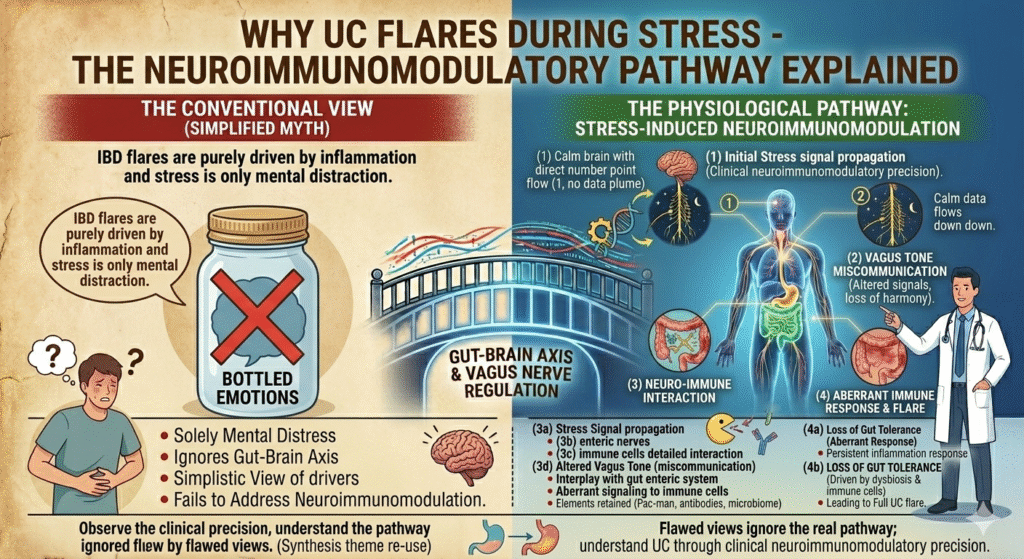
There’s a pervasive myth that ulcerative colitis (UC) flares are merely random, unfortunate events, or solely caused by diet. This could not be further from the truth. Current research shows a direct and potent link between stress and inflammatory bowel disease (IBD). Specifically, UC flares are deeply intertwined with the neuroimmunomodulatory pathway. Understanding the mechanisms at play is crucial for those managing these chronic, often debilitating conditions.
Stress as a Catalyst: The Vagus Nerve and the Enteric Nervous System
Stress is not an abstract concept when discussing UC flares. It is a measurable catalyst that engages specific physiological pathways. Central to this is the vagus nerve, the linchpin of the parasympathetic nervous system. The vagus nerve communicates directly with the enteric nervous system, which governs your gut’s function. During states of stress, the hypothalamic-pituitary-adrenal (HPA) axis becomes activated. This axis releases cortisol and other stress hormones into the bloodstream. Elevated cortisol levels then engage with the vagus nerve, disrupting normal digestive processes and weakening gut barrier function. The compromised gut barrier leads to increased intestinal permeability, often referred to as “leaky gut,” a known precursor to IBD flares.
Beyond the conventional view of stress, we now understand it as a multifactorial phenomenon impacting neural pathways. The role of the vagus nerve in this intricate system cannot be overstated. It’s not merely a passive channel; it’s an active participant in stress-induced immune dysregulation. Understanding this reshapes how one must approach stress management in the context of UC.
The Gut-Brain Axis: More Than Just a Connection
The gut-brain axis is a complex bidirectional communication system between the central nervous system and the enteric nervous system. Polyvagal theory offers robust insights into how emotional and physiological states affect this axis. During stress, the sympathetic nervous system’s heightened state can lead to altered gut motility and increased sensations of incomplete evacuation, further exacerbating UC symptoms. The brain-gut communication isn’t just a dialogue; it becomes a chaotic exchange during episodes of stress.
Neurotransmitters such as serotonin and gamma-aminobutyric acid (GABA) are involved in this interplay, influencing not just mood but also gut physiology. The imbalance of these neurotransmitters during stress contributes to the dysregulation seen in UC flares. The altered communication within the gut-brain axis provides clarity on why symptoms can feel unpredictable; it’s a communication breakdown on a neurochemical level.
Immune Modulation: The Enzymatic Pathway of Inflammation
In the context of UC, stress doesn’t just stop at the neural interaction; it directly impacts immune response. The neuroimmunomodulatory pathway, specifically involving nuclear factor kappa-light-chain-enhancer of activated B cells (NF-κB), plays a crucial role. Stress-induced signals via the vagus nerve modulate NF-κB, an enzyme linked to inflammatory responses. When NF-κB is activated, it initiates a cascade of inflammatory cytokines that exacerbate intestinal inflammation characteristic of UC.
This cascade is a clear biophysical manifestation of stress-induced immune dysregulation. Unlike simplistic interpretations that overlook biological processes, this linkage offers a straightforward explanation for flare-ups. Stress impacts enzyme pathways, modulating immune responses that precipitate UC symptoms.
The unequivocal truth here is this: ulcerative colitis is not simply a dietary or genetic puzzle. It is a neuroimmunological condition, deeply influenced by stress through specific neural and enzymatic pathways. These insights demand an educated, precise approach to stress management, directly informed by science, not speculation.
**Meta Description:**
Stress isn’t just bad for UC; it’s catalytic. Discover how neuroimmunomodulatory pathways and the vagus nerve deepen your flare-ups.