Let’s dismantle the myth: Irritable Bowel Syndrome (IBS) is merely a disorder of the gut. The misconception stops here. In truth, IBS is tightly coiled with the nervous system, particularly the vagus nerve. This connection means gut health can’t be decoupled from the state of your nervous system. A nuanced understanding bridges the gap between gut symptoms and nervous system dysregulation, facilitated by mechanisms you won’t hear about in a standard consultation.
The Enteric Nervous System: The Gut’s Brain
The enteric nervous system (ENS), often dubbed the ‘second brain,’ plays a pivotal role in gut motility, enzyme secretion, and interaction with gut microbes. Its million neurons are hardwired to function independently, yet its alignment with the central nervous system via the gut-brain axis is crucial. This axis isn’t a metaphor; it’s a literal pathway where signals transmitted through the vagus nerve influence digestive function. Dysregulation here can lead to the altered peristalsis seen in IBS.
Contrary to what you may have been told, the vagus nerve’s influence on gut behavior is not minor. It’s central. When vagal tone is weak, a cascade of dysregulated signals can promote or exacerbate the symptoms of IBS. Activation of the vagus nerve, and by extension the parasympathetic nervous system, helps modulate inflammation and improve gut function. Recognize the enteric nervous system as a dynamic entity; it interprets stress and recalibrates digestion, revealing why safety is non-negotiable for optimal gut function.
Polyvagal Theory: The Safety-Digestion Nexus
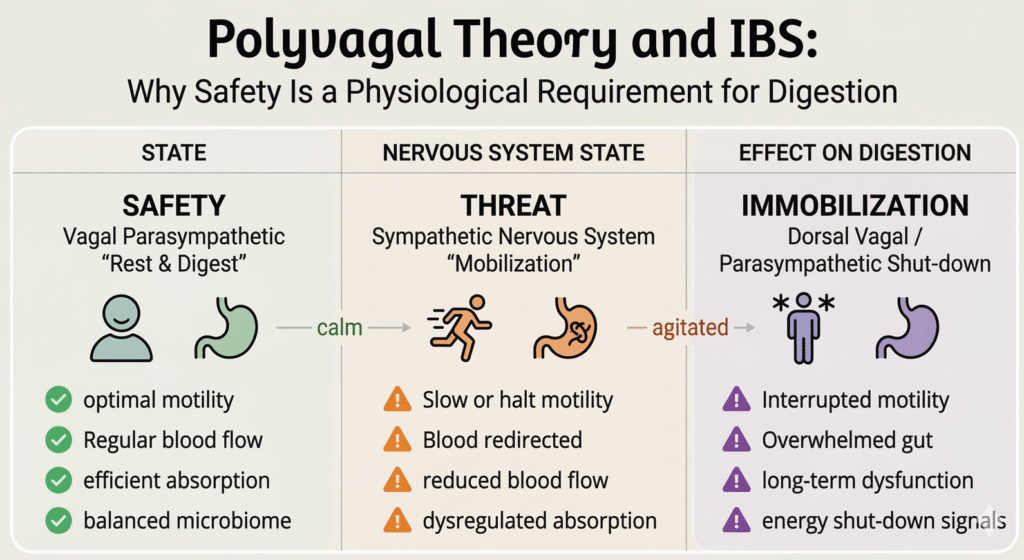
Polyvagal Theory, articulated by Dr. Stephen Porges, provides a framework for understanding the role of the autonomic nervous system in relation to social engagement and the state of the gut. The theory clarifies how the body’s state of perceived safety, processed through the vagus nerve, impacts digestive efficiency. The vagus nerve operates through two branches: one promoting rest and digest, the other the fight or flight response.
For IBS sufferers, the pathway of defense dominates, skewing the gut-brain axis towards dysregulation. Neuroception, a process through which the nervous system unconsciously evaluates environmental safety, triggers autonomic states that can disrupt gastrointestinal equilibrium. A calm, socially engaged state enhances vagal tone, facilitating digestive processes and supporting motility and immune function. Polyvagal Theory is not mere theory; it’s a cornerstone in understanding why the gut demands a state of calm for its optimal operation.
**Clinical Mechanisms: From Enzymes to Nerves**
The dysfunction in IBS is as much a nervous system issue as it is a gastrointestinal one. Consider the enzyme motilin, key in regulating the migrating motor complex (MMC), a gut peristalsis driver. With vagus nerve dysregulation, motilin secretion is compromised, resulting in the erratic contractions characteristic of IBS. The vagus nerve’s modulation of acetylcholine, a neurotransmitter fostering healthy gut motility, further illustrates the interconnectedness of nervous and gut functions. When the parasympathetic state is suppressed, diminished acetylcholine exacerbates IBS symptoms.
You’re not just experiencing faulty digestion; your IBS is intrinsically linked to disrupted vagal pathways. This comprehensive dialogue between neurons, neurotransmitters, and gut hormones is evidence that IBS cannot be tackled through isolated gut-centric approaches. It mandates an advanced understanding of the gut-nervous system axis for effective management.
**The Final Word: Vagus, Nervous System, Digestion Converge**
Understanding IBS demands more than interest, it requires a systemic shift in perception. The gut doesn’t operate in isolation; it’s a responsive endpoint to the nervous system, especially the vagus nerve. Integration is not a wellness buzzword; it’s a clinical necessity. The focus should be on enhancing vagal tone, understanding polyvagal influences, and acknowledging the vital operations of the ENS. These aren’t abstract links but tangible pathways that demand respect. Safety, as perceived by the nervous system, isn’t a mere sentiment; it’s physiological bedrock for digestion.