You clear your throat before a meeting. Then again halfway through. By evening your voice feels tired, there is a sticky layer of mucus that never quite goes, and sometimes it feels like a small lump is sitting just behind your collarbone.
You may not even get heartburn. That is exactly why silent reflux throat clearing confuses so many people. You might have been told it is an allergy, a cold that never left, or “just acidity”. Perhaps you have been on Pantoprazole for weeks and the throat still feels the same. Let us look at why this happens and what tends to help.
What silent reflux throat clearing actually is
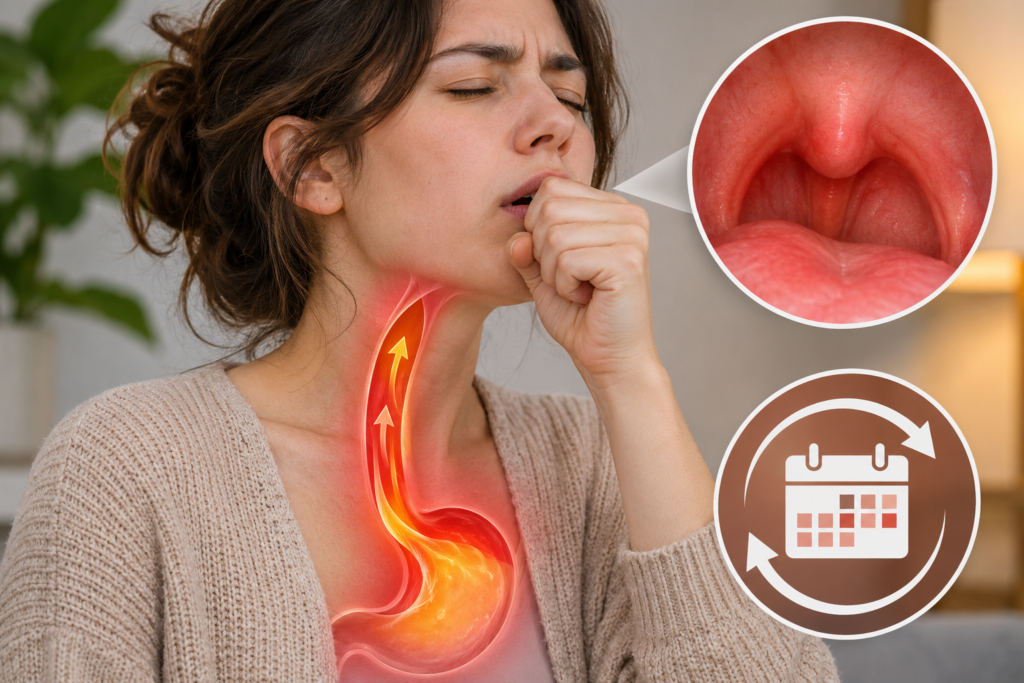
Silent reflux is the everyday name for laryngopharyngeal reflux, often shortened to LPR. Instead of stomach contents causing a burning feeling in the chest, small amounts travel higher, up to the throat and voice box.
The tissue in your throat is far more delicate than the lining of your food pipe. Even tiny amounts of refluxed material can leave it irritated and swollen. Your body responds the only way it knows: it makes protective mucus and it tells you to clear your throat.
Common silent reflux symptoms
People describe it in many ways. These are the ones I hear most often:
- Constant throat clearing, especially after meals or when you lie down
- A feeling of mucus in the throat due to acidity that you cannot swallow away
- A lump in the throat feeling, sometimes called globus
- A hoarse or tired voice by the end of the day
- A dry, tickly cough that comes and goes
- A bitter taste in the morning or after a heavy dinner
Because many of these overlap with allergies and nasal drip, a clear medical assessment matters. A recent review in the Mayo Clinic Proceedings notes that the lump in the throat feeling can come from nasal, food pipe, reflux, structural and psychological causes, so it should not be assumed to be one thing.
Why your throat clearing will not stop, even on PPIs
PPIs like Pantoprazole work. They lower stomach acid, and for many people with classic reflux they are helpful and sometimes necessary. So why does the throat often stay irritated?
A 2026 state of the art review on laryngopharyngeal reflux explains that a large share of throat reflux events are not strongly acidic. Many are weakly acidic, alkaline or even gaseous. Digestive enzymes such as pepsin can still irritate throat tissue in these conditions. A PPI reduces acid, but it does not stop the reflux itself from reaching the throat.
This is one reason a PPI can calm chest burning but leave the throat clearing behind. If this sounds familiar, you may also find it useful to read why acid reflux can continue even after Pantoprazole.
Please do not change your medication based on this. Any decision about starting, stopping or switching treatment belongs with your treating clinician, who can also discuss options and testing that suit you.
Here’s what many people don’t realise
Throat clearing is not only a reflux problem. It is also a habit loop and a nervous system signal.
Every time you clear your throat, the vocal cords bang together. That friction irritates them a little more, which makes more mucus, which makes you want to clear again. Over months, the throat becomes more sensitive and the urge arrives faster.
A 2026 review building on the San Diego Consensus describes exactly this. It found that heightened sensitivity, hypervigilance and symptom specific anxiety were more strongly linked to throat symptoms than the actual amount of reflux measured. In other words, a throat that has been irritated for a long time can stay on high alert even when reflux is reduced.
So the goal is a calmer, less reactive throat, not a perfect stomach. And healing usually means retraining, not just restricting.
The deeper drivers: the Triple System Model
In my work I look at silent reflux through three connected systems. When only one is addressed, symptoms tend to return.
1. Digestive chemistry
How well you break down food matters. Slow digestion, large late dinners and long gaps followed by heavy meals all increase pressure in the stomach. That pressure pushes contents upward, especially when you lie down soon after eating.
2. Nervous system regulation
The valve at the top of your stomach and the muscles of your throat are both influenced by the vagus nerve. When you live in a constant rush, eat at your desk and sleep poorly, your body stays in a stressed state. Digestion slows, the valve relaxes at the wrong moments, and the throat becomes more reactive.
3. Subconscious conditioning
After months of discomfort, the brain learns to scan the throat. You notice every tickle. You clear before you even feel the need. I often see this with my clients: the clearing has become automatic, almost like a reflex the body runs on its own. This is not imagined. It is learned, and what is learned can be gently unlearned.
What tends to help silent reflux throat clearing
These are general, educational steps. They are not a treatment plan, and they work best alongside guidance from your doctor.
Change your meal rhythm
- Finish dinner at least three hours before you lie down.
- Make dinner the lighter meal of the day where possible.
- Avoid going very long without food and then eating a large plate quickly.
- Notice personal triggers such as very late tea or coffee, fried snacks or alcohol, rather than cutting whole food groups.
Eat in a calm state
Sit down, take three slow breaths before your first bite, and chew well. Eating while scrolling or answering messages keeps your body in a stressed mode, which works against digestion.
Break the clearing loop
When you feel the urge to clear, try a gentler swap. Take a small sip of water and swallow hard. Or hum softly with your lips closed. Each time you replace a harsh clear, you give the throat a chance to settle. It feels small, but repeated daily it adds up.
Breathwork and vagus nerve practices
Slow belly breathing helps both the nervous system and the diaphragm, which supports the valve at the top of the stomach. Try breathing in through the nose for four counts, letting the belly rise, then out slowly for six counts. Five minutes, twice a day, is a good start. Humming and gentle gargling with plain water are other easy vagus nerve practices.
Protect your sleep
Raising the head end of your bed slightly, sleeping on your left side and keeping a steady bedtime can all reduce night time reflux. Good sleep also lowers the next day’s stress load.
Reintroduce, do not keep restricting
If you have cut out many foods, bring them back slowly, one at a time, in small portions, at your calmest meal of the day. The goal is better tolerance, not permanent restriction.
Where the RENEW Method fits
The RENEW Method is the framework I use to work across all three systems. It begins by Restoring digestive signalling and Easing nervous system overload, so the stomach and throat are no longer under constant pressure. We then Notice subconscious patterns such as automatic clearing and throat scanning, Establish new body responses, and finally Wire new identity patterns so you stop living as “someone with a bad throat”.
It is not a quick fix, and it is never a replacement for medical care. It is a structured way to address what diet changes and tablets alone often leave untouched.
These signs need proper examination, and a throat scope or endoscopy may be advised.
Frequently asked questions
Can silent reflux cause constant throat clearing?
Yes. When small amounts of stomach contents reach the throat, the delicate tissue becomes irritated and produces protective mucus. That mucus and irritation trigger an urge to clear. Over time, frequent clearing irritates the vocal cords further, so the habit can continue even when reflux is reduced. A doctor can confirm whether reflux is involved.
Why do I have mucus in my throat due to acidity even on Pantoprazole?
Pantoprazole lowers stomach acid, but research shows many throat reflux events are weakly acidic, alkaline or gaseous. Enzymes like pepsin can still irritate the throat. Throat sensitivity and stress also play a role. Speak to your treating clinician before changing any medication, as they can review your plan with you.
How long does it take for silent reflux symptoms to settle?
It varies from person to person. The throat lining is slow to calm once it has been irritated for months, so many people notice gradual change over several weeks rather than days. Consistent meal timing, calmer eating, better sleep and reducing harsh throat clearing tend to support steady progress over time.
Is a lump in the throat feeling always caused by reflux?
No. A lump in the throat feeling can come from nasal drip, reflux, food pipe conditions, stress and, less commonly, structural problems. That is why a proper medical check is important, especially if you have trouble swallowing, weight loss or a lasting change in your voice. Do not assume it is reflux without assessment.
You do not have to keep clearing your throat forever
If you have been dealing with reflux, throat clearing or that stubborn lump feeling for two years or more, and you have already tried the diets and the tablets, it may be time to look at the full picture. You are welcome to apply for a Gut Audit Call. In 45 minutes we will look at your digestion, your nervous system and your patterns together, and map out what may be keeping your throat stuck.
This article is for education and is not a substitute for medical advice. Please don’t start or stop any prescribed medication without reviewing it with your treating clinician.
References
- Lechien JR, Johnston N, Savarino E, et al. Evaluation and Management of Laryngopharyngeal Reflux Disease: An Updated State of the Art Review. Otolaryngol Head Neck Surg. 2026. PubMed 42647076
- Walsh E, Guadagnoli L, Barkmeier Kraemer JM, et al. Laryngopharyngeal Symptoms and Laryngopharyngeal Reflux Disease: Interdisciplinary Considerations and Management. Neurogastroenterol Motil. 2026;38(6):e70383. PubMed 42333440
- Naik I, Vukkadala N, Kamboj AK. An Approach to Globus Sensation: Clinical Pearls for Clinicians. Mayo Clin Proc. 2026;101(7):1202 to 1210. PubMed 42383934
- Shaheen NJ, Howden CW, Yadlapati R, Katz PO. Modern Diagnosis and Management of Acid Related Disorders. Clin Gastroenterol Hepatol. 2026. PubMed 42822575
Leave a Reply