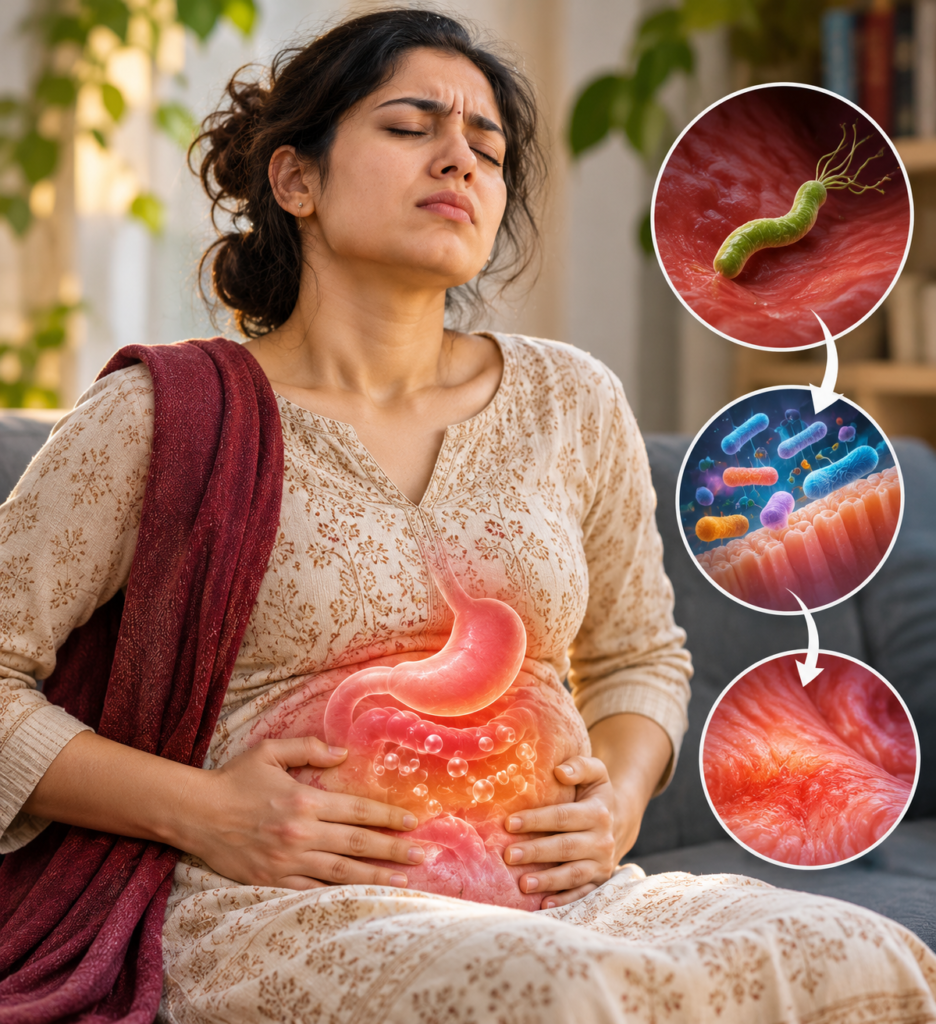
You finished the full course of antibiotics. You took every capsule on time, even the ones that left a metallic taste in your mouth. Your follow up test came back negative. And yet, a few weeks or months later, your stomach still balloons after lunch, you burp through meetings and your trousers feel tighter by evening.
If you are dealing with bloating after H. pylori treatment, you are not imagining it, and you are far from alone. In this article, I will walk you through why the gas and bloating can linger after a successful treatment, what is really going on underneath, and the gentle, practical steps that help your gut settle again.
Why Bloating After H. pylori Treatment Is So Common
H. pylori treatment usually combines two or three antibiotics with a strong acid lowering medicine such as Pantoprazole for 10 to 14 days. This treatment matters. Clearing H. pylori lowers the risk of ulcers and stomach cancer, and it is the right call when your doctor recommends it.
But a powerful treatment also leaves a footprint. Research shows that the gut microbiota is shaken up straight after eradication therapy. It then recovers gradually, and the speed of recovery depends on the regimen. In one review, gut bacterial diversity had returned by about 8 weeks after triple therapy, but had not fully recovered even at one year after some quadruple and concomitant regimens.
So a negative test tells you the infection is gone. It does not tell you that your digestion is back to normal. Those are two different questions.
What Is Really Driving the Gas and Burping
In my work, I look at long standing gut symptoms through what I call the Triple System Model: digestive chemistry, nervous system regulation and subconscious conditioning. After H. pylori treatment, all three are often out of balance at the same time.
1. Digestive chemistry
Antibiotics thin out many of the friendly bacteria that help break down fibre and keep gas producing microbes in check. Acid suppression during treatment also changes the environment in the stomach and small intestine. When food is not broken down well higher up, more of it reaches bacteria lower down, and fermentation means gas, distension and that heavy, stretched feeling after meals.
2. Nervous system regulation
Your gut is wired directly to your brain through the gut brain axis. Scientists now call conditions like functional dyspepsia and IBS disorders of gut brain interaction. Reviews describe how stress, an altered microbiome and low grade immune activity can make the nerves in the gut more sensitive. This is called visceral hypersensitivity. A normal amount of gas then feels like a lot of pressure.
If you spent months worried about your diagnosis, your nervous system may still be on high alert. A body in fight or flight mode slows digestion, and the upper stomach does not relax properly to receive a meal. That alone can create fullness and burping.
3. Subconscious conditioning
I often see this with my clients: after a long stretch of stomach trouble, the body learns to brace before every meal. You scan for discomfort, you swallow more air when tense and you start avoiding foods out of fear. Over time, this protective pattern keeps the gut in a guarded state, even after the original trigger has gone.
Here’s What Many People Don’t Realise
Here’s what many people don’t realise: lingering symptoms after treatment do not automatically mean the infection is back or that the treatment failed.
A large Japanese study of more than 23,000 endoscopy records, discussed in a 2026 editorial, found that 28.7% of people still reported upper abdominal pain or bloating after successful eradication. That was about the same rate seen in people who had never had H. pylori at all. The authors pointed to several possible reasons, including changes in acid secretion, more sensitive gut nerves and shifts in the gut microbiome.
In other words, the bacteria may have been one piece of your story, not the whole story. The goal now is to help your gut regain its rhythm and resilience, not to keep hunting for the next thing to kill.
This is also why repeating more antibiotics, or cutting out food after food, often leaves people more frustrated. The goal is better tolerance, not permanent restriction.
How Long Does It Take for the Gut to Recover After H. pylori Treatment?
There is no single timeline, and anyone who promises you one is guessing. Research on the microbiome suggests recovery is gradual and takes weeks to months, and it can be slower after stronger regimens.
What I find matters more than the calendar is direction. Are your symptoms slowly easing, or have they stayed the same or got worse for several months? If they are stuck, it is worth looking deeper at all three systems, not only at food. If you are also struggling with burning or acidity, you may find my article on burning after H. pylori treatment helpful.
What Tends to Help Bloating After H. pylori Treatment
These are general, safe habits that support digestion while your gut recovers. They are for education, and they work best alongside the care plan from your treating doctor.
- Eat in a calm state. Sit down, put the phone away and take three slow breaths before your first bite. Digestion works best when your body feels safe.
- Chew more, rush less. Well chewed food is easier to digest, and eating slowly means you swallow less air, which cuts down on burping.
- Keep a steady meal rhythm. Regular meal times, with a gap of three to four hours and no constant grazing, give your stomach and small intestine time to clear between meals.
- Try smaller portions. Reviews on functional dyspepsia suggest smaller, more frequent meals can ease fullness, because a sensitive stomach handles a lighter load more comfortably.
- Use your breath to calm your vagus nerve. Slow belly breathing with a longer out breath, for example in for 4 counts and out for 6, for five minutes after meals, can help shift your body towards rest and digest.
- Protect your sleep. Your gut lining and your nervous system do much of their repair work overnight. Aim for a regular bedtime and an early, lighter dinner.
- Reintroduce foods gradually. Rather than living on a shrinking list of safe foods, bring back one food at a time in small amounts. Simple, home cooked Indian meals such as dal, rice and lightly spiced vegetables are often a good base.
- Move gently after meals. A 10 to 15 minute walk after lunch or dinner helps gas move along and supports natural gut movement.
Notice what is not on this list: another strict diet, a cupboard full of supplements or self prescribing more medicine. Healing is often about doing less, more consistently.
Where the RENEW Method Fits
The RENEW Method is the framework I use with clients who have had gut symptoms for years. It works through five steps: Restore digestive signalling, Ease nervous system overload, Notice subconscious patterns, Establish new body responses and Wire new identity patterns.
For bloating after H. pylori treatment, this means we do not stop at food. We gently support digestion, calm a nervous system that has been on guard for a long time, and help your body unlearn the bracing and fear that keep symptoms going. It is a whole system approach, not a quick fix.
Frequently Asked Questions
Is it normal to have bloating after H. pylori treatment?
Yes, it is common. Antibiotics and acid suppression disturb your gut bacteria for a while, and a sensitive nervous system can make normal gas feel uncomfortable. Research shows many people still report bloating after successful eradication. If symptoms are severe, worsening or come with red flags, please see your doctor.
How long does gas last after H. pylori treatment?
It varies from person to person. Studies suggest gut bacteria recover gradually over weeks to months, and sometimes longer after stronger regimens. Focus on whether your symptoms are slowly improving. If gas and bloating have not eased after a few months, speak to your doctor and look at digestion, stress and eating habits together.
Does bloating after treatment mean H. pylori has come back?
Not necessarily. Many people feel bloated even after a confirmed negative test, because of changes in gut bacteria, acid levels and gut sensitivity. The only way to know whether the infection is still present is a proper test, such as a breath or stool test, which your doctor can arrange.
Can stress cause bloating after H. pylori treatment?
Yes, stress can play a big role. Your gut and brain are closely connected through the gut brain axis. When you are anxious or under pressure, digestion slows and gut nerves become more sensitive, so bloating and burping feel worse. Calming practices like slow breathing and eating in a relaxed state often help.
Ready to Feel at Ease in Your Gut Again?
If you have been struggling with bloating, gas or other gut symptoms for two years or more, and you feel you have tried everything, I would love to help you understand what your body is really asking for. Apply for a Gut Audit Call here. It is a 45 minute session where we look at your digestion, nervous system and patterns together, and map out your next steps.
This article is for education and is not a substitute for medical advice. Please don’t start or stop any prescribed medication without reviewing it with your treating clinician.
References
- Liou JM, Lee YC, El Omar EM, Wu MS. Efficacy and long term safety of H. pylori eradication for gastric cancer prevention. Cancers (Basel). 2019;11(5):593. PubMed 31035365
- Liou JM, Lee YC, Wu MS. Treatment of Helicobacter pylori infection and its long term impacts on gut microbiota. J Gastroenterol Hepatol. 2020;35(7):1107 to 1116. PubMed 31984532
- Lu JG, Gao YZ. Dyspepsia following H. pylori eradication: shifts in etiology and clinical challenges. World J Gastroenterol. 2026;32(6):115699. PubMed 41695278
- Oshima T. Functional dyspepsia: current understanding and future perspective. Digestion. 2024;105(1):26 to 33. PubMed 37598673
- Vanuytsel T, Bercik P, Boeckxstaens G. Understanding neuroimmune interactions in disorders of gut brain interaction. Gut. 2023;72(4):787 to 798. PubMed 36657961
- Malfertheiner P, et al. Management of Helicobacter pylori infection: the Maastricht VI/Florence consensus report. Gut. 2022;71(9):1724 to 1762. PubMed 35944925
Leave a Reply