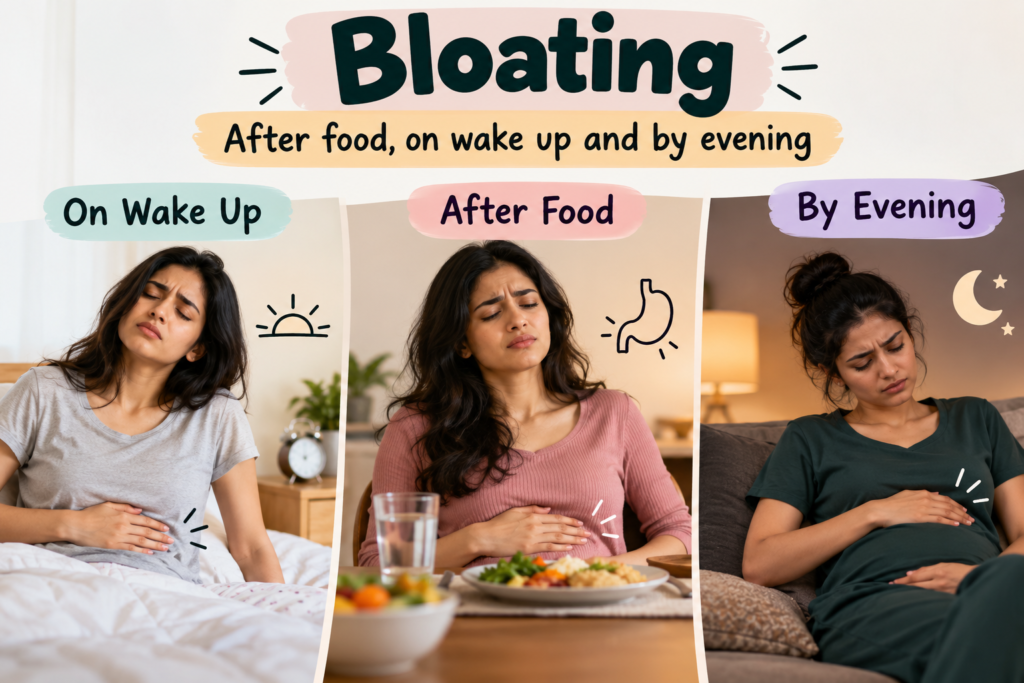
You wake up with a flat stomach. By lunch your waistband feels a little tight. By 7 pm you are unbuttoning your jeans, your belly looks five months pregnant, and you are wondering what you did wrong. You ate a light lunch. You skipped the maida. You even had jeera water.
Bloating worse in the evening, almost every single day? You are not imagining it and you are not alone. It is one of the most common patterns I see. In this article, I will explain why your stomach gets bloated by evening, why cutting more foods rarely fixes it, and what tends to help.
Why bloating gets worse in the evening
Bloating that builds through the day is rarely about one meal. It is about what your gut has been carrying, and how your body has been responding, since morning.
Doctors separate two things. Bloating is the feeling of pressure, fullness or trapped gas. Distension is a visible increase in the size of your belly. They often happen together, but not always. A review from Mayo Clinic gastroenterologists lists several drivers: food intolerances, a past gut infection that disturbed the gut bacteria, a sensitive gut, slow movement of food, and an abnormal reflex between the gut and the abdominal muscles.
Here is how those drivers stack up over a typical working day.
- Gas and food volume add up. Every meal, chai and snack adds volume and fermentation. If food moves slowly, the load keeps building instead of clearing.
- Gravity and posture. Sitting hunched at a desk for eight hours compresses the belly and changes how the diaphragm moves.
- Stress accumulates. Deadlines, traffic, back to back calls. Your nervous system spends the day in a guarded state, and digestion is one of the first things it turns down.
- The gut gets more sensitive. A tired, stressed nervous system turns up the volume on normal gut sensations, so the same amount of gas feels like much more.
Overnight, with rest and an empty stomach, much of this settles. That is why the morning can feel so different.
The Triple System Model: it is not just food
In my work, I look at chronic gut symptoms through three connected systems. I call it the Triple System Model. Evening bloating is a very clear example of how all three overlap.
1. Digestive chemistry
This is the part most people focus on: stomach acid, enzymes, bile, gut bacteria and how well food is broken down. Rushed meals, low appetite in the morning and a heavy late dinner can all strain this system. A history of repeated antibiotics, long term acid suppressing medicines or a past infection can also leave the gut bacteria out of balance. These medicines often do their job and can be necessary. The point is simply that recovery of the gut environment can take time.
2. Nervous system regulation
Your gut has its own nervous system, and it listens closely to your brain. When you are in a stressed, fight or flight state, digestion slows, the gut becomes more reactive, and gas is not moved along as smoothly. This is the gut brain axis in daily life.
3. Subconscious conditioning
If you have struggled with bloating for years, your body may have learned to expect it. You eat, you brace, you check your belly, you worry about how you look. That bracing is not a choice. It is a learned protective pattern, and it keeps the nervous system on alert around food.
Here’s what many people don’t realise about evening bloating
Many people with a visibly swollen belly do not actually have much more gas than anyone else. Research groups in Barcelona and across Europe have described a reflex called abdominophrenic dyssynergia. In simple words, after a meal the diaphragm pushes down when it should relax, and the front belly muscles let go when they should hold gently. The belly gets pushed out.
The 2025 European consensus on functional bloating lists this reflex, along with a sensitive gut, slow gut movement and imbalanced gut bacteria, as key drivers. A 2024 randomised trial found that people with meal triggered distension who were taught to retrain this diaphragm pattern had less visible swelling after a test meal and fewer symptoms, compared with a placebo group.
So the goal is a calmer, better coordinated body, not a smaller and smaller plate. If you would like to understand the diaphragm side of this better, read my earlier post on why your diaphragm controls your bowel movements.
What tends to help evening bloating
These are general, practical steps. They are education, not a prescription, and they work best when done gently and consistently.
- Front load your day. Eat a proper breakfast and lunch, and keep dinner lighter and earlier, ideally two to three hours before bed. Many professionals do the opposite: little all day, then a big late dinner.
- Eat in a calm state. Before you eat, take five slow breaths. Sit down. Put the phone away. Chew well. Your body digests better when it feels safe.
- Practise belly breathing after meals. Sit upright, one hand on your chest and one on your belly. Breathe in slowly through the nose so the lower ribs widen, then breathe out longer than you breathe in. Five minutes after lunch and dinner. The AGA expert review mentions diaphragmatic breathing as an option for this belly muscle reflex.
- Break up long sitting. A short walk of ten to fifteen minutes after meals and a stretch every hour help gas move along.
- Watch the sipping and gulping. Fizzy drinks, chewing gum, eating very fast and talking while eating all add swallowed air.
- Protect your sleep. Poor sleep makes the gut more sensitive the next day. A regular bedtime is quietly one of the best gut habits.
- Reintroduce, do not just remove. If you have cut out many foods, work with a qualified professional to reintroduce them slowly. The goal is better tolerance, not permanent restriction.
I often see this with my clients: they arrive with a long list of foods they are afraid of, yet their bloating is still worse every evening. That is a strong clue the issue is not only on the plate.
Where the RENEW Method fits
The RENEW Method is the framework I use to work on all three systems together, in order.
- Restore digestive signalling, so the gut breaks down and moves food well.
- Ease nervous system overload, so the body can shift into rest and digest.
- Notice subconscious patterns, like bracing and food fear.
- Establish new body responses around meals.
- Wire new identity patterns, so you stop living as someone with a problem stomach.
It is not a quick fix and it does not replace medical care. It is a structured way to address why the bloating keeps returning, not just what you ate today.
FAQs about bloating worse in the evening
Why is my stomach flat in the morning but bloated at night?
Through the day, food, gas, long sitting and stress add up. A stressed nervous system slows digestion and makes the gut more sensitive. Some people also have a diaphragm reflex that pushes the belly out after meals. Overnight rest lets much of this settle, so the morning feels flatter.
Is it normal to be bloated every evening?
Mild fullness after dinner is normal. Bloating that makes you unbutton your clothes every evening, or that has lasted months, is common but worth looking into. It is usually functional, meaning no damage is found, but it is still real. See a doctor first if you have any warning signs.
Can stress cause bloating by evening?
Yes, it can contribute. Stress shifts the body into fight or flight, which slows digestion and makes the gut more sensitive to normal amounts of gas. After a long, pressured workday, that effect is often at its peak. Calming practices before and after meals can help many people.
Should I stop eating dinner to reduce evening bloating?
Skipping meals usually backfires. It often leads to overeating later and more stress around food. A better approach is a proper breakfast and lunch, a lighter, earlier dinner, and eating slowly in a calm state. If bloating persists, discuss it with your doctor or a qualified gut health professional.
Ready to understand your bloating?
If you have been struggling with bloating for two years or more and you are tired of guessing, I would love to help you see the full picture. Apply for a Gut Audit Call. In 45 minutes we will look at your digestion, nervous system and patterns together, so you know what to focus on next.
References
- Lacy BE, Cangemi D, Vazquez Roque M. Management of Chronic Abdominal Distension and Bloating. Clin Gastroenterol Hepatol. 2021. PubMed 32246999
- Melchior C, et al. European Consensus on Functional Bloating and Abdominal Distension: ESNM/UEG Recommendations for Clinical Management. United European Gastroenterol J. 2025. PubMed 40844856
- Moshiree B, Drossman D, Shaukat A. AGA Clinical Practice Update on Evaluation and Management of Belching, Abdominal Bloating, and Distention: Expert Review. Gastroenterology. 2023. PubMed 37452811
- Barba E, et al. Thoracoabdominal Wall Motion Guided Biofeedback Treatment of Abdominal Distention: A Randomized Placebo Controlled Trial. Gastroenterology. 2024. PubMed 38467383
- Malagelada JR, Accarino A, Azpiroz F. Bloating and Abdominal Distension: Old Misconceptions and Current Knowledge. Am J Gastroenterol. 2017. PubMed 28508867
Leave a Reply