You finished your course of Rifagut. For a few weeks, the bloating settled and you finally felt normal after meals. Then a stressful month at work arrived, the deadlines piled up, sleep got shorter, and the heavy, gassy, bloated feeling came straight back.
So you start wondering: can stress cause SIBO, or is it just a coincidence? It is one of the most common questions I hear, and the honest answer is more useful than a simple yes or no. Let’s look at what the science actually says, and what you can do with it.
What SIBO actually is, in simple words
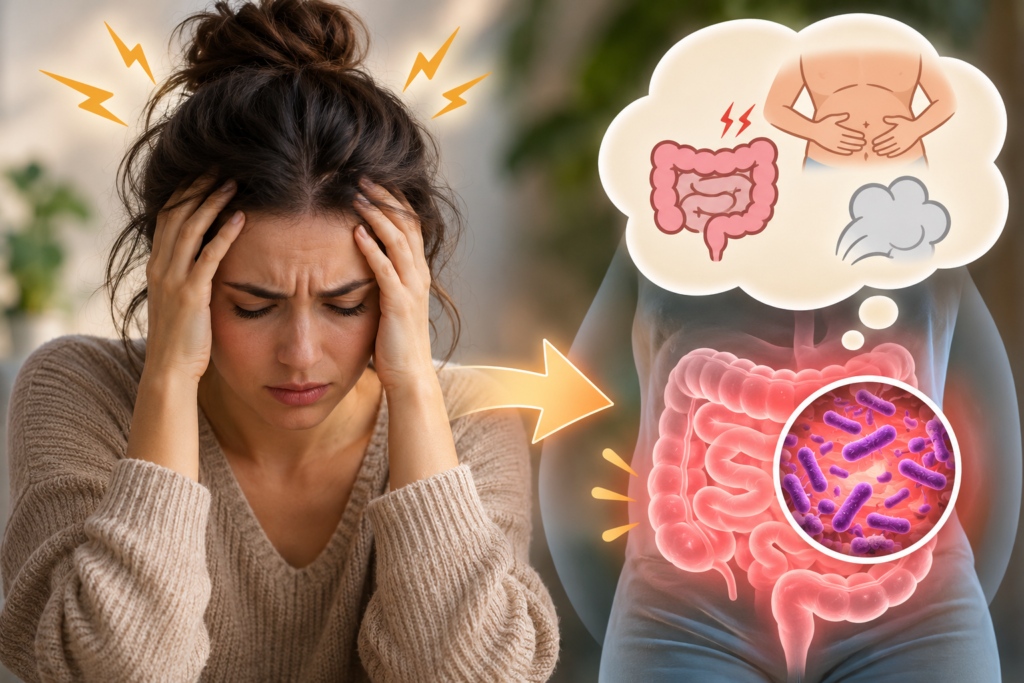
SIBO stands for small intestinal bacterial overgrowth. Your large intestine is meant to hold huge numbers of bacteria. Your small intestine is meant to hold far fewer. When too many bacteria build up in the small intestine, they ferment food early, and that can lead to bloating, gas, belching, discomfort, loose stools or constipation.
The American College of Gastroenterology guideline describes SIBO as excess bacteria in the small bowel causing gut symptoms, and it is usually assessed with a breath test and treated with antibiotics such as rifaximin (sold in India as Rifagut). These medicines work, and for many people they are a necessary step.
But clearing bacteria is one part of the picture. The bigger question is why they built up in the first place.
Can stress cause SIBO? The honest answer
Here’s what many people don’t realise: there is no strong evidence that stress on its own directly creates SIBO. Research is still limited. One small study from Poland found that people with SIBO reported higher stress and anxiety than people without it. Another study in IBS patients found that anxiety and life stress scores were similar whether or not people had SIBO.
So stress is not a proven single cause. What stress can do is weaken the systems that normally keep bacteria in their proper place. Think of it as a door opener, not the burglar.
Stress and the gut’s cleaning wave
Between meals, your gut runs a cleaning wave called the migrating motor complex. It sweeps leftover food and bacteria out of the small intestine, roughly every 90 minutes or so when you are not eating. I’ve written about it in detail in The Migrating Motor Complex: The Gut’s Internal Cleaning System.
A review by Takahashi explains that this wave is influenced by the vagus nerve, and animal research showed that stress weakened the stomach part of this wave through reduced vagal activity. When the cleaning wave slows, food and bacteria can linger longer than they should.
Stress, stomach acid and digestive signalling
When your body is in fight or flight mode, digestion is put on hold. Saliva, stomach acid and enzyme release are part of the rest and digest state. Stomach acid is one of your natural defences that keeps bacteria from travelling too far down. Long term acid suppression with PPIs such as Pantoprazole changes this defence too, which is one reason doctors prescribe them thoughtfully.
Why SIBO keeps coming back after Rifagut
If your symptoms return a few months after treatment, you are not imagining it, and you are not alone. A study in the American Journal of Gastroenterology followed 80 people after successful rifaximin treatment. About 44 percent tested positive again within 9 months. Older age, a past appendix removal and long term PPI use were linked with a higher chance of recurrence.
This tells us something important. The antibiotic does its job, but if the underlying drivers stay the same, the conditions for overgrowth can return. That is why I often see this with my clients: several rounds of treatment, a little relief each time, then the same cycle again.
The Triple System view: why food is only one piece
In my work I look at SIBO through the Triple System Model. Lasting relief usually needs all three systems to move in the right direction, not just the diet.
- Digestive chemistry: stomach acid, bile, enzymes and the cleaning wave that keep the small intestine clear. Repeated PPIs, antibiotics and irregular eating can all affect this.
- Nervous system regulation: the vagus nerve tells your gut when it is safe to digest and move. A body stuck in constant alert sends weaker digestive signals.
- Subconscious conditioning: after years of symptoms, the body can learn to brace before every meal. Food fear, gut checking and worry about the next flare keep the stress response switched on.
The goal is a gut that moves and digests well, not a plate that keeps getting smaller.
What tends to help: calm, practical steps
These are general, educational steps that support the systems above. They work alongside your doctor’s treatment, never instead of it.
- Space your meals. Many people find that 3 meals with gaps of about 4 hours, and fewer constant snacks, give the cleaning wave a chance to run. Check with your clinician if you have diabetes or other conditions.
- Eat in a calm state. Sit down, put the phone away and take 3 slow breaths before the first bite. Chew well. Digestion starts in a relaxed body, not a rushed one.
- Practise daily vagus nerve breathing. Try breathing in for 4 counts and out for 6 to 8 counts, for 5 minutes, once or twice a day. Humming or gentle gargling are other simple options.
- Protect your overnight gap. Finish dinner 2 to 3 hours before bed so the overnight cleaning wave has time to work, and aim for regular sleep timings.
- Reintroduce foods gradually. Long, strict diets can shrink your food list and raise food fear. Reintroducing foods slowly, with guidance, supports better tolerance, not permanent restriction.
- Notice your stress patterns. Write down when bloating flares. Many people discover a link with rushed lunches, late dinners or tense days, not just certain foods.
Where the RENEW Method fits
The RENEW Method is the framework I use to bring these pieces together: Restore digestive signalling, Ease nervous system overload, Notice subconscious patterns, Establish new body responses and Wire new identity patterns. It does not replace medical tests or treatment. It focuses on the parts that a course of antibiotics cannot reach, like how your body responds to food, stress and safety.
When to see your doctor
Please see your doctor promptly if you notice any of these:
- Blood in your stool or black, tarry stools
- Unexplained weight loss
- Persistent vomiting or difficulty swallowing
- Anaemia, or ongoing fatigue that is getting worse
- Symptoms that wake you at night
- Fever with severe abdominal pain
- New gut symptoms after the age of 45 to 50
Also speak to your doctor before stopping or changing any medicine, including PPIs or antibiotics.
Frequently asked questions
Can stress cause SIBO on its own?
Current research does not show that stress alone causes SIBO. Stress can slow the gut’s cleaning wave, reduce digestive signalling and affect stomach acid, which may make overgrowth more likely in some people. It is usually one driver among several, alongside medicines, past surgery, slow motility and other medical conditions.
Why does my SIBO come back after Rifagut?
Rifaximin often clears symptoms, but research shows recurrence is common, with about 44 percent testing positive again within 9 months in one study. Long term PPI use, older age and past appendix removal raised the risk. If the underlying drivers stay the same, the overgrowth can return.
Can anxiety make SIBO bloating worse?
Yes, it can for many people. Anxiety keeps the body in alert mode, which can slow digestion and make the gut more sensitive to normal gas and stretch. So even the same amount of gas can feel more uncomfortable. Calming the nervous system often improves how symptoms feel day to day.
How can I calm my nervous system for gut health?
Start small and stay consistent. Try slow breathing with a longer out breath for 5 minutes, eat sitting down without screens, keep regular meal and sleep times, and spend time outdoors. These habits support the vagus nerve, which helps your gut move and digest food more comfortably.
Ready to look at the whole picture?
If you have been dealing with bloating or SIBO for 2 years or more, and you are tired of repeating the same treatments without lasting change, you don’t have to figure this out alone. Apply for a Gut Audit Call and we’ll look at your digestion, nervous system and patterns together, so you know your clearest next step.
This article is for education and is not a substitute for medical advice. Please don’t start or stop any prescribed medication without reviewing it with your treating clinician.
References
- Pimentel M, Saad RJ, Long MD, Rao SSC. ACG Clinical Guideline: Small Intestinal Bacterial Overgrowth. Am J Gastroenterol. 2020. PubMed 32023228
- Lauritano EC, et al. Small intestinal bacterial overgrowth recurrence after antibiotic therapy. Am J Gastroenterol. 2008. PubMed 18802998
- Takahashi T. Interdigestive migrating motor complex: its mechanism and clinical importance. J Smooth Muscle Res. 2013. PubMed 24662475
- Kossewska J, et al. Personality, Anxiety, and Stress in Patients with Small Intestine Bacterial Overgrowth Syndrome. Int J Environ Res Public Health. 2022. PubMed 36612414
- Chu H, et al. Small Intestinal Bacterial Overgrowth in Patients with Irritable Bowel Syndrome: Clinical Characteristics, Psychological Factors, and Peripheral Cytokines. Gastroenterol Res Pract. 2016. PubMed 27379166
Leave a Reply