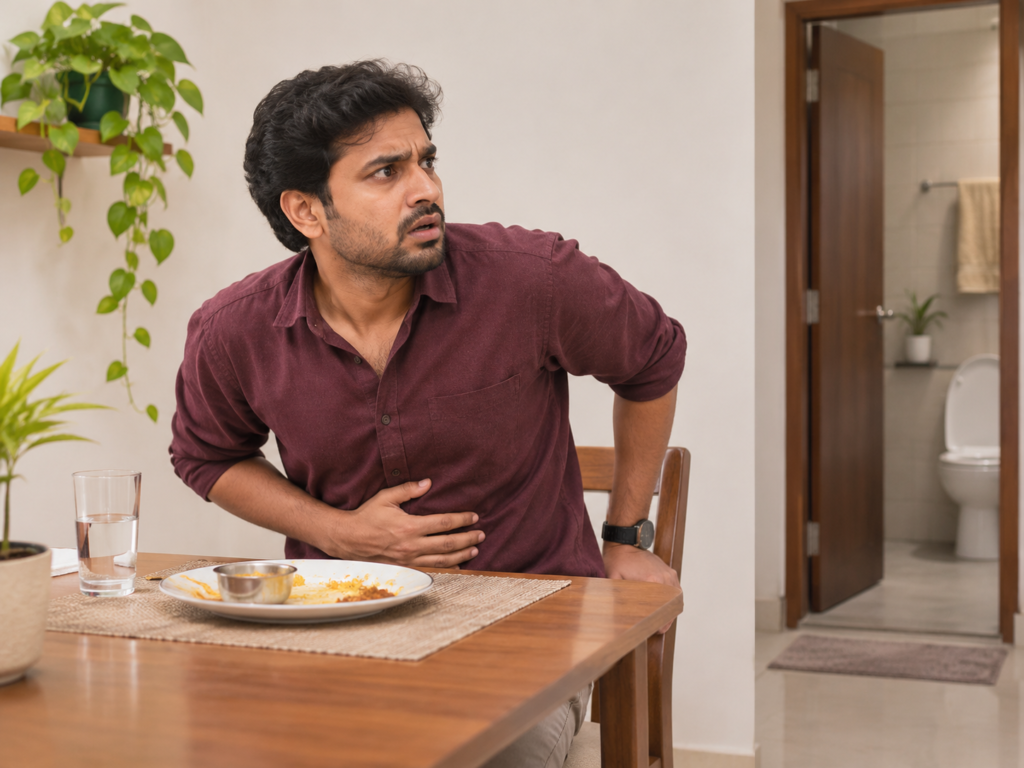
You sit down for lunch at your desk. Ten minutes later, before you have even finished, there is that familiar cramp and the rush to find a washroom. It happens after breakfast, after lunch, sometimes after just a cup of chai.
If you need the toilet right after eating, almost every meal, you are not imagining it. You may have started planning meals around washroom access, skipping food before meetings or travel, and quietly wondering if something is badly wrong.
Let’s look at what is really happening, and why the answer is rarely just about what is on your plate.
Why You Need the Toilet Right After Eating
There is a normal reflex at work here. Doctors call it the gastrocolic reflex, or gastrocolonic response. When food reaches your stomach, signals travel to your colon (large intestine) and tell it to start moving.
A review in Current Gastroenterology Reports describes this as a physiological increase in colon activity that usually begins within minutes of a meal. It is mediated by the vagus nerve and hormone signals, and it is triggered by things like the stomach stretching, the calories in the meal and especially the fat content.
So the urge itself is not a disease. Everyone has this reflex. It is why many people feel like going after their morning tea.
When a normal reflex becomes a daily problem
The trouble starts when the reflex is too strong, too fast or too painful. Instead of a gentle nudge, you get urgency, cramping and sometimes loose motion after every meal.
I often see this with my clients who have lived with IBS for years. The reflex is still the same reflex. What has changed is how loudly the gut and the nervous system respond to it.
The Gastrocolic Reflex in IBS: Three Systems, Not One
In my work I use what I call the Triple System Model. It looks at digestive chemistry, nervous system regulation and subconscious conditioning together, because all three shape how your gut reacts to food.
1. Digestive chemistry
Rich, oily or very large meals push the reflex harder, since fat and stomach stretch are known triggers. Some carbohydrates ferment quickly in the gut and produce gas and fluid, which can add to cramping in people with IBS.
A research review in Gut also suggests that in some people with IBS, meal related symptoms may involve a local immune response in the gut lining, which can follow an earlier gut infection, and can make the nerves more sensitive.
2. Nervous system regulation
The vagus nerve carries the message from stomach to colon. When your body is stuck in a stressed, rushed state, the gut becomes more reactive and more sensitive to normal movement.
Eating lunch while answering emails, or gulping breakfast before a commute, means food is arriving into a body that already feels under pressure.
3. Subconscious conditioning
Here’s what many people don’t realise. Your brain can start the reflex even before you take a bite. A small study in Neurogastroenterology and Motility found that simply seeing or smelling food increased colon activity in more than half of the patients tested.
After months of urgency, your brain learns to link food with danger: “If I eat, I will need to run.” That anticipation alone can turn up the response. This is not weakness or something “in your head”. It is a learned body response, and learned responses can be retrained.
Why Cutting More Foods Rarely Fixes It
Most people respond by eating less, skipping meals or living on plain rice and curd. It feels logical. Yet the urgency often stays.
Diet can genuinely help some people with IBS. A review in Nutrients notes that limiting rapidly fermented carbohydrates, as in a low FODMAP approach, helps many patients, while also noting that food intolerances in IBS are complex and not fully understood.
But endless restriction has a cost. Smaller, irregular meals and constant food fear can make the gut more reactive, not less. The goal is better tolerance, not permanent restriction.
If mornings are your worst time, you may also find my article on loose motion due to anxiety useful, since the stress loop behind it is closely related.
What Tends to Help a Rushing Gut
These are general, educational steps, not a treatment plan. They work best when practised gently and consistently.
- Keep a steady meal rhythm. Eat at similar times each day. Regular, moderate meals usually create a calmer reflex than one huge meal after a long gap.
- Go easier on very heavy, oily meals. Since fat is a known trigger for the reflex, notice whether fried or rich meals bring on stronger urgency, and adjust portion size rather than banning foods outright.
- Eat in a calm state. Sit down, put the phone away for the first few minutes and chew slowly. Your gut digests best when your body feels safe.
- Try slow breathing before meals. Breathe in through your nose for about four counts and out for about six, for two to three minutes. Long, slow exhales support the calming side of the nervous system through the vagus nerve.
- Protect your sleep. Poor sleep tends to make the gut more sensitive the next day. A consistent bedtime is one of the simplest supports you can give your digestion.
- Reintroduce foods gradually. If you have cut out many foods, bring them back one at a time in small amounts, so your gut and your brain can relearn that food is safe.
The international Rome Foundation also recognises brain gut behaviour therapies, such as gut directed hypnotherapy and cognitive behavioural therapy, as evidence based options for disorders of gut brain interaction like IBS. That tells you how central the nervous system is to this problem.
Where the RENEW Method Fits
The RENEW Method works through the same three systems, in order: Restore digestive signalling, Ease nervous system overload, Notice subconscious patterns, Establish new body responses and Wire new identity patterns.
For a gut that rushes after every meal, this means supporting digestion, calming the stress response around eating, and gently retraining the learned link between food and urgency. Sequence matters, not just the steps.
Frequently Asked Questions
Is it normal to need the toilet right after eating?
Yes, to a degree. The gastrocolic reflex makes your colon more active within minutes of eating, and everyone has it. It becomes a concern when the urge is urgent, painful or leads to loose motion after most meals, or when it comes with red flag symptoms like blood, weight loss or night time diarrhoea.
What is the gastrocolic reflex in IBS?
It is the same reflex everyone has, where food in the stomach signals the colon to move. In IBS the gut and its nerves are often more sensitive, so the response can feel stronger and faster, with cramping and urgency. Stress, heavy meals and anticipation of symptoms can all make it more intense.
Why do I get loose motion after every meal?
Common contributors include a very reactive gastrocolic reflex, rich or oily meals, quickly fermenting foods, eating in a rushed or stressed state, and a gut that has become sensitised over time. Infections and other conditions can also cause it, so persistent loose motion deserves a medical check before you assume it is IBS.
Can stress make me need the toilet after eating?
Yes. The vagus nerve links your stomach, brain and colon, so a stressed nervous system can make the colon respond more strongly to food. Your brain can even trigger colon activity when you see or smell food. Calm eating and slow breathing often help reduce this response over time.
How can I stop rushing to the toilet after meals?
Start with a steady meal rhythm, moderate portions, calmer eating and slow breathing before meals. Notice whether very oily meals make it worse. Avoid extreme restriction, since food fear can keep the gut reactive. If it has lasted for years, work with your doctor and a practitioner who addresses the gut brain connection.
You Don’t Have to Plan Your Life Around a Washroom
If you have been rushing to the toilet after meals for two years or more, and diets and supplements have only taken you so far, it may be time to look at all three systems together. You can apply for a Gut Audit Call where we map what is driving your symptoms, or take my free gut quiz to understand your pattern. No pressure, just clarity.
References
- Dorfman L, El Chammas K, Mansi S, Kaul A. Gastrocolonic Response. Curr Gastroenterol Rep. 2022;24(11):137 to 144. PubMed
- Dorfman L, Wongteerasut A, El Chammas K, et al. Novel sensory trigger for gastrocolonic response. Neurogastroenterol Motil. 2023;35(5):e14528. PubMed
- Ford AC, Staudacher HM, Talley NJ. Postprandial symptoms in disorders of gut brain interaction and their potential as a treatment target. Gut. 2024;73(7):1199 to 1211. PubMed
- Spiller R. Impact of Diet on Symptoms of the Irritable Bowel Syndrome. Nutrients. 2021;13(2):575. PubMed
- Keefer L, Ballou SK, Drossman DA, et al. A Rome Working Team Report on Brain Gut Behavior Therapies for Disorders of Gut Brain Interaction. Gastroenterology. 2022;162(1):300 to 315. PubMed
Leave a Reply