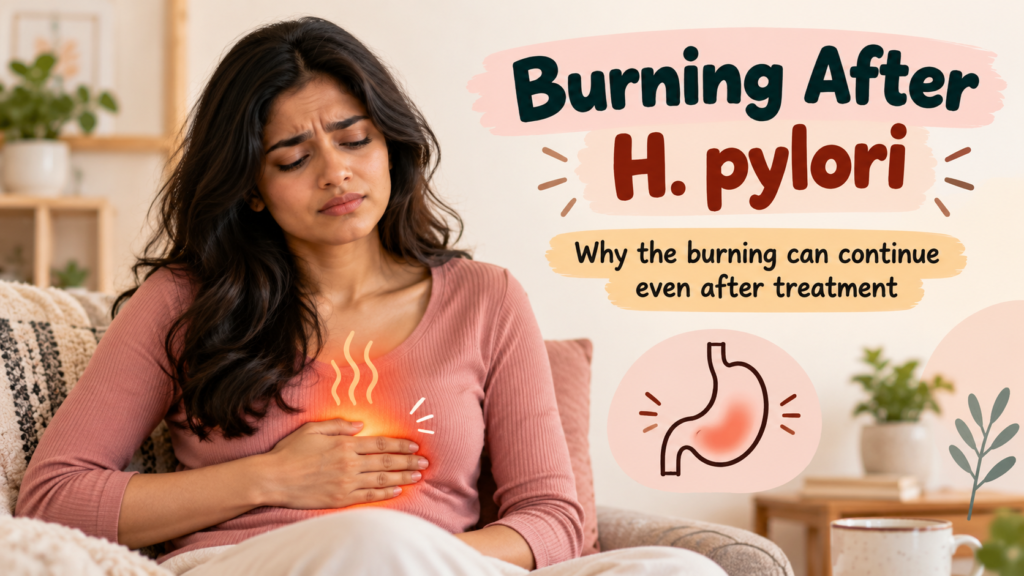
You finished the full course. The tablets, the antibiotics, the strict routine. Maybe your breath test or stool test even came back clear. And yet, a few weeks later, the burning is still there. It shows up after dinner, on an empty stomach in the morning, or right when you lie down.
If you are dealing with burning after H. pylori treatment, you are not imagining it, and you are not alone. It is one of the most common worries I hear. The infection may be gone, but your stomach, your gut bacteria and your nervous system are still catching up. Let’s look at why.
Why the Burning Can Continue After H. pylori Treatment
H. pylori treatment usually combines two or three antibiotics with a strong acid reducing tablet. It is effective and often necessary. But clearing the bacteria is one step. Recovery of the systems around it is another.
Here are the most common reasons the burning lingers.
1. The stomach lining needs time to settle
H. pylori often leaves behind inflammation in the stomach lining, called gastritis. Removing the bacteria takes away the trigger, but the lining does not reset overnight. While it heals, it can stay sensitive to spicy food, coffee, large meals and long gaps between meals.
2. Acid can rebound when acid reducers stop
Many people take PPIs like Pantoprazole for weeks or months before and during treatment. When long term PPIs are stopped, the stomach can temporarily make more acid than before. This is called rebound acid hypersecretion. In one review, about 44% of healthy volunteers had heartburn or regurgitation for up to four weeks after stopping a PPI, even though they had no symptoms before.
This is why acidity after H. pylori treatment can feel like the problem has come back, when the stomach may simply be readjusting. Please don’t change your PPI on your own because of this. Discuss it with your doctor, who can guide the right plan for you.
3. Reflux can show up after eradication in some people
Research on heartburn after H. pylori eradication is mixed. A 2025 review of studies found that reflux disease was diagnosed more often after successful eradication. A Japanese study found reflux related inflammation in around 10% of people a year after treatment, but it also found that overall reflux symptom scores improved over those 12 months.
So the picture is not “treatment causes reflux”. It is that a small group of people notice reflux after treatment, and for many, symptoms ease gradually over time. Eradication is still important because of its long term benefits for the stomach.
4. Antibiotics shift your gut bacteria
A strong antibiotic course can unsettle the balance of bacteria in your gut for a while. That is why some people notice bloating, gas, loose stools or stomach burning after antibiotics. Usually this settles, but if digestion was already struggling, recovery can feel slower.
Here’s What Many People Don’t Realise
I often see this with my clients. By the time many people finish H. pylori treatment, they have been anxious about their stomach for months, sometimes years. Every meal has felt like a test. Every burning episode has felt like proof that something is still wrong.
Here’s what many people don’t realise: your gut and brain talk to each other constantly through the gut brain axis. When your nervous system stays on high alert, the gut becomes more sensitive. Normal sensations can feel sharper, digestion slows, and burning feels louder. The body is still bracing for a threat that may already be gone.
This is where my Triple System Model comes in. Lasting relief usually needs attention on three levels, not just one:
- Digestive chemistry: acid balance, the healing lining, meal rhythm and gut bacteria.
- Nervous system regulation: whether your body is in a calm “rest and digest” state or a stressed “fight or flight” state when you eat.
- Subconscious conditioning: the learned fear around food and symptoms that keeps the alarm switched on.
The goal is a calmer, more resilient stomach, not a longer list of banned foods.
What Tends to Help Reflux After H. pylori Treatment
These are general, gentle steps that support recovery. They work alongside your doctor’s advice, not instead of it.
- Eat on a steady rhythm. Long gaps followed by a heavy meal can make burning worse. Regular, moderate meals give the lining a predictable routine.
- Finish dinner earlier. Try to leave two to three hours between your last meal and lying down.
- Eat in a calm state. Sit down, put the phone away, and take three slow breaths before your first bite. Digestion works best when the body feels safe.
- Practise slow breathing daily. Breathing in for four counts and out for six, for five minutes, supports the vagus nerve, which helps regulate digestion.
- Protect your sleep. Poor sleep raises stress hormones and lowers your pain threshold, which can make burning feel stronger.
- Reintroduce foods gradually. Instead of cutting more and more foods, slowly bring back simple home foods in small amounts and notice how you feel. Better tolerance, not permanent restriction, is the aim.
- Review your plan with your doctor. Ask whether a test to confirm the infection has cleared is needed, and how to safely manage your acid reducing medicine going forward.
If your burning feels like reflux that keeps returning even on medication, you may also find this helpful: Acid Reflux Even After Pantoprazole? The Real Reasons.
Where the RENEW Method Fits
I created the RENEW Method for people whose symptoms continue even after the medical treatment has done its job. It works in five stages: Restore digestive signalling, Ease nervous system overload, Notice subconscious patterns, Establish new body responses, and Wire new identity patterns.
For someone with burning after H. pylori treatment, this often means supporting the stomach’s natural rhythm, calming the stress response around meals, and gently letting go of the fear that every sensation is a relapse. It works alongside medical care, never against it.
Frequently Asked Questions
Is it normal to have burning after H. pylori treatment?
Yes, it is common. The stomach lining may still be healing, acid can rebound after stopping PPIs, and antibiotics can unsettle gut bacteria. For many people, symptoms ease gradually over weeks to months. If the burning is severe, worsening or comes with red flag symptoms, please see your doctor.
How long does acidity last after H. pylori treatment?
It varies from person to person. Rebound acid after stopping long term PPIs was seen for up to four weeks in studies of healthy volunteers. Healing of the stomach lining and nervous system can take longer. Your doctor can advise you based on your test results and history.
Can H. pylori treatment cause reflux?
Some studies have found reflux is diagnosed more often after successful eradication, while others found reflux symptoms overall were similar or improved over time. Treatment is still recommended because clearing H. pylori protects the stomach long term. If reflux appears, discuss it with your doctor.
Does burning after treatment mean H. pylori has come back?
Not necessarily. Burning can come from a healing lining, rebound acid or a sensitive gut brain connection. The only way to know whether the infection has cleared is a test your doctor recommends, such as a breath or stool test. Please don’t assume either way without checking.
What can I eat when my stomach burns after H. pylori treatment?
Simple, warm, home cooked meals in moderate portions are often easier, such as rice, dal, khichdi, curd rice and cooked vegetables. Eat at regular times and in a relaxed state. Reduce obvious triggers for now, then reintroduce foods slowly so your gut builds tolerance.
You Don’t Have to Figure This Out Alone
If you have been dealing with burning, acidity or reflux for two years or more, and you are tired of guessing what to eat next, I would love to help you understand what is really going on. You can apply for a Gut Audit Call here. We will look at your digestive chemistry, nervous system and patterns together, and map out a calmer way forward.
References
- Wang H, et al. Helicobacter pylori infection and eradication in relation to gastroesophageal reflux disease. J Gastroenterol Hepatol. 2025. PubMed 40662427
- Sugimoto M, et al. Risk of reflux related symptoms and reflux esophagitis after eradication treatment in the Japanese population. J Clin Med. 2021. PubMed 33916067
- Lødrup AB, Reimer C, Bytzer P. Systematic review: symptoms of rebound acid hypersecretion following proton pump inhibitor treatment. Scand J Gastroenterol. 2013. PubMed 23311977
- Namikawa K, Björnsson ES. Rebound acid hypersecretion after withdrawal of long term proton pump inhibitor treatment: are PPIs addictive? Int J Mol Sci. 2024. PubMed 38791497
- Targownik LE, Fisher DA, Saini SD. AGA clinical practice update on de prescribing of proton pump inhibitors: expert review. Gastroenterology. 2022. PubMed 35183361
Leave a Reply